
WORLD RADIO NORMANDY CAEN
All of Normandy, in English
London, UK
A Very British Prohibition: The 18th Century Gin Craze
by


9 September 2025
Britain once had its own prohibition
WIT | Episode 02
Picture yourself in 18th-century London, where gin costs less than bread. Reformers rage, politicians argue. Workers slump in the streets, alleys reek of cheap spirits and signs boast “Drunk for a penny!” But how did a simple drink become the city’s most notorious vice?
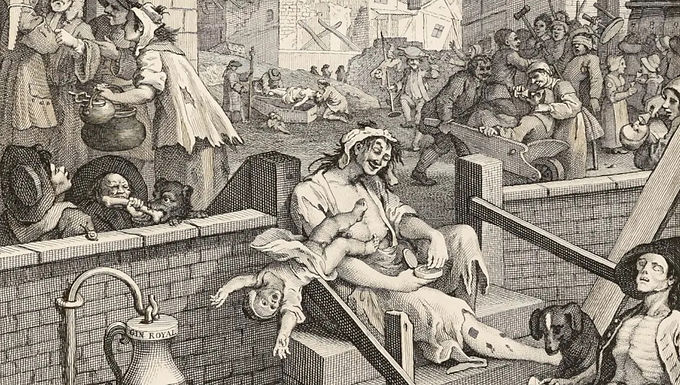
Gin Lane by William Hogarth (1759) | © Royal Academy of Arts
Step into 18th-century London, and you might overhear locals talk about sipping “Old Tom,” “Poverty,” “South Sea Mountain,” “Cock-My-Cap,” and even “My Lady’s Eye-water.” But these weren’t the latest trends in fashionable cocktails; they were the quirky, secret code names for gin that gripped the city with an intoxicating frenzy. You may also stumble upon a bizarre urban ritual: doors marked with the image of a cat. Thirsty Londoners would knock and shout “puss,” prompting a mysterious meow from within. Moments later, a drawer would slide out through a hole, money would pass inside, and before you knew it, a clandestine bottle of gin would emerge. These weren’t simple shopfronts; they were covert operations run by anonymous gin sellers, ever wary of informers as they fuelled the city’s notorious addiction to gin. This may sound strange to us now, but this is the little-known story of prohibition in 18th-century Britain.
A bit of Dutch courage
Gin originates from the Netherlands. The term derives from the Dutch word for juniper spirits: Geneva or Jenever, which was eventually shortened to Gin. This is the likely origin of the expression “Dutch courage,” as soldiers would drink gin before heading into battle to steady their nerves. Gin was popularised in Britain after 1688, following the ascension of William of Orange, a Dutchman, to the throne. William passed a series of acts through parliament to encourage gin production. He then declared war on France and imposed a ban on trade with the new enemy, meaning brandy could no longer be imported. This created a significant gap in the market. Gin was easy to produce and farmers had a surplus of grain to spare. As a result, gin became a commercial commodity and the poor were treated to a variety of flavours, all at a very affordable price. Unlike brandy, gin was within the reach of anyone’s pocket, rich or poor!
Boom, bust and booze
At the start of the 18th century, London was thriving. In 1711, the South Sea Company struck a deal with the government to swap debt for equity and gain exclusive trading rights in Spanish America. This sparked a huge speculative boom in London as investors, from aristocrats to ordinary tradesmen, flocked to buy its shares. This is known as the South Sea Bubble. During this period, London experienced a new era of risk, with gambling, prostitution and plenty of gin. People thronged to parties and casinos, becoming fixated on the stock exchange’s boom and bust and the twists and turns of the gambling table. Gin was at the centre of it all. Signs outside gin shops read “Drunk for a penny. Dead drunk for twopence. Straw for nothing.” But in 1720, the bubble finally burst. Rich and poor alike were swept up in the turmoil. Over a third of London’s banks went bankrupt. Poverty was widespread, and the impoverished numbed their pain with gin. By 1723, the average Londoner was consuming a pint of gin per week. This triggered the gin panic.
Spirits and scandal
The 1720s saw a reform movement based on conservatism and Christianity. But instead of addressing poverty, the reformers blamed gin for London's woes. Gin was at the forefront of political debate and was splashed across the headlines of London’s newspapers. In 1934, a woman named Judith Dufour murdered her two-year-old daughter, Mary, whilst drunk on gin. With a friend’s help, they tied a handkerchief around her neck to stop her from crying and strangled her. They then took away her clothes, which the parish had donated, and sold them to buy more gin. Dufour was found guilty and publicly hanged. The trial made headlines nationwide and Dufour became a figurehead for the anti-gin movement.
It was around this time that the first report of its kind, detailing a medical case against the abuse of spirits, was published. Entitled “A Friendly Admonition to the Drinkers of Brandy and other distilled spirituous liquors,” Dr Stephen Hales presented a medical argument, backed by experiment, which informed readers that excessive gin drinking can harm the liver and lead to brain damage and heart disease. He even went as far as to detail how addictive gin can be and further advised that pregnant women and breastfeeding mothers should not drink it, as it can be harmful to children. Amidst the widespread panic dissipated by the press, the Gin Act of 1736 was passed, which effectively served as a prohibition for the poor. It imposed a 20 shilling per gallon excise and a £50 retail licence, along with hefty fines for those who failed to comply. This was far beyond what any poor person could afford, effectively meaning only the very rich could drink gin.
Policing without a police force
The authorities anticipated a revolt in response to the Gin Act. On the 29th September 1736, the day it was enacted, soldiers patrolled the streets of London, bracing for a riot. But there was no riot, no display of opposition. Nothing. There was no surge of people paying the £50 retail licence either and gin continued to be sold on the streets. The Gin Act was simply being ignored.
Enforcing the Gin Act was extremely difficult. There was no official police force at the time, only volunteer magistrates with limited resources. They had to rely on informers to denounce gin sellers. An informer would buy themselves some gin, then inform on the person they bought it from and the court would reward them with half of the £10 fine the gin seller had to pay. This amount was more than the poorest would earn in a whole year, so there was no shortage of informers.
The informers were immensely unpopular. Angry mobs of gin enthusiasts frequently attacked them. In October 1937, an informer was cornered by a crowd and beaten to death with sticks. His wife and friend tried to help, but they were also beaten. Three informers were murdered in November and one of their funerals saw an uproar with a mob pelting his coffin. In January 1738, London experienced a riot involving 1,000 people protesting against informers. The Gin Act was tearing society apart, yet people were still drinking gin. By the end of 1738, the magistrates were worn out, informers were too afraid to come forward and the Gin Act was no longer enforceable, so the authorities ultimately gave up trying.
The failed prohibition
Although the Gin Act was no longer enforced, it was not officially repealed until 1743. The Act had transformed law-abiding citizens into criminals, removing the drink trade from mainstream society and transferring it to organised crime. During the seven years that the Act was in effect, spirit production increased by more than a third. In 1743, when gin was supposed to be outlawed, on average, each Londoner was drinking two pints a week.
Why the sudden move to repeal it now?
Britain participated in the War of the Austrian Succession in the 1740s and the prime minister recognised gin’s potential as a major source of revenue for the nation. The Gin Act of 1943 abolished the tacit ban for the poor and made it more affordable to generate funds for the war.
However, this isn’t the end of the gin story: after the war in 1748, the soldiers returned and both drinking and crime increased. The conflict between gin drinkers and reformers persisted. It wasn’t until 1751, with the final Gin Act, that a compromise was reached: a higher tax was imposed that was not excessive for the poor, which made gin more expensive but still affordable. This encouraged people to drink in moderation.
Lessons from the gin craze
As the historian Jessica Warner argues, poverty was the true problem for London in the 18th century. Poverty was the root cause of excessive drinking and gin was simply used as a scapegoat for the social and economic issues of the era. However, the reformers concentrated on the effect rather than the cause. The Gin Act removed impoverished London’s anaesthetic. The Gin Craze reflects contemporary debates over cheap alcohol, recreational drugs or even fast food. It serves as a reminder of how dangerous unregulated access to cheap intoxicants can be, how social inequality exacerbates substance abuse and how policy responses must balance practicality with compassion. It also reminds us that public perceptions can overstate crises, but that doesn’t mean the underlying problems aren’t real.
Sources:
Allred, Nicholas. "Mother Gin and the Bad Examples: Figuring a Drug Crisis, 1736-51." Eighteenth-Century Fiction 33, 3 (2021): 369-389.
Byrne, Eugene. “What Is the Origin of the Phrase ‘Dutch Courage’?” History Extra, July 26, 2013. https://www.historyextra.com/period/general-history/what-is-the-origin-of-the-phrase-dutch-courage/. Accessed: 30 July 2025.
Dillon, Patrick. Gin: The Much-Lamented Death of Madam Geneva and the 18th Century Gin Craze. London: Lume Books, 2021.
Warner, Jessica. Craze: Gin and Debauchery in an Age of Reason. London: Profile Books, 2003.

